
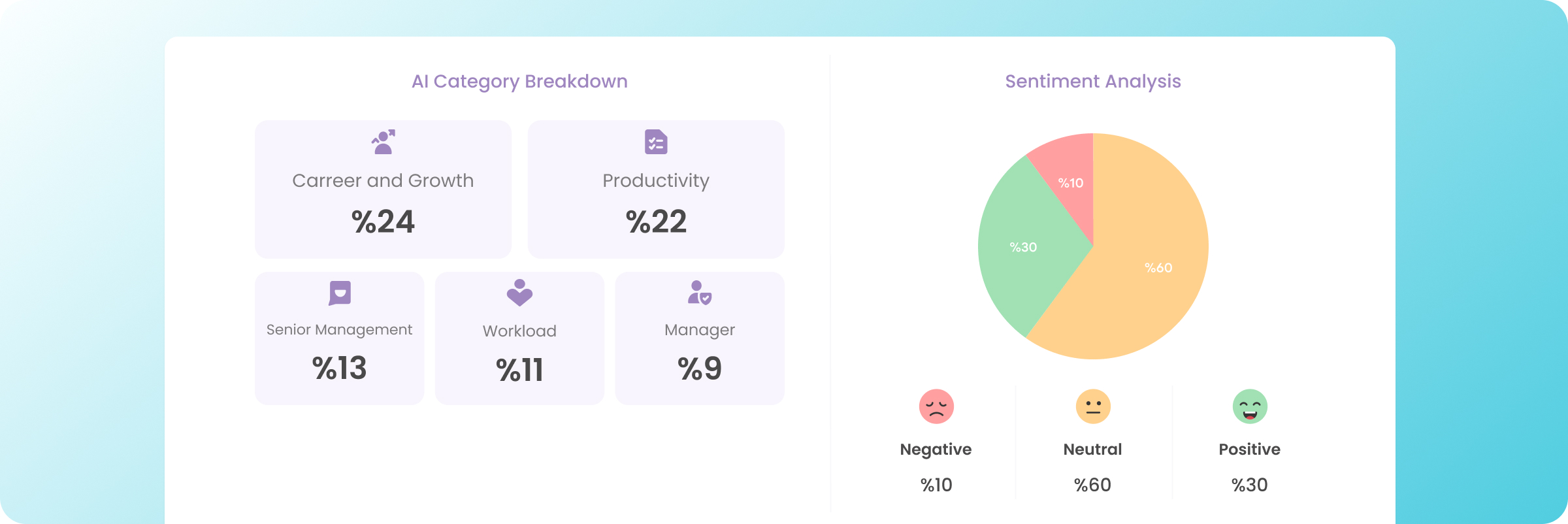
We all experience a swirl of emotions—stress, pride, worry, accomplishment—with little time to reflect. Imagine capturing those feelings in a few sentences and instantly getting insight into what’s going on… plus guidance to boost your drive. That’s where AI can help. By analyzing employee feedback, it can break them into meaningful categories and reveal the emotional tone. It can guide you toward clarity, understanding, and motivation.
Why Categorizing Emotions Helps
When feelings are broad and fuzzy, it’s hard to act on them. Labeling the emotions in categories like “workload” “manager” or “productivity” helps make them manageable. Categorization turns the amorphous into the actionable.
Sentiment Analysis: The Emotional Thermometer
Sentiment AI doesn’t just classify feedback—it measures the tone and intensity. Labels the feedback: negative, neutral or positive. These gradations help you understand where you should take action.
Behind the Curtain: How It Works
-
Input: You get feedback, like “I’m juggling too much and I feel stuck.”
-
Category Detection: AI assigns your sentence to categories—e.g., workload, productivity.
-
Sentiment Scoring: It flags tone—e.g., negative sentiment.
Real-World Use Cases
-
Daily Mood Check‑Ins: AI gives you insights on how your employees feel and categorizes the context under categories.
-
Self‑Coaching Tools: Use it to reframe negativity to opportunity.
Conclusion
AI can bring power to your emotional journey—teasing out meaning, highlighting tone, and guiding action. When you categorize feelings and see their sentiment, motivation isn’t far behind.



 Linkedin


